ANGKOR VIHARA PROJECT
EXPLORING THERAVADA BUDDHIST MONASTIC CONSTRUCTION AT ANGKOR THOM, CAMBODIA

The Angkor Vihara Project (AVP), directed by Archaeology Centre Research Associate Dr. Andrew Harris (Anthropology ’21), investigates religious transformation, social change, and population resilience at the capital of Angkor, Cambodia, through the adoption of Theravāda Buddhist practices and infrastructures within the urban citadel of Angkor Thom (c. 13th -16th centuries). Traditionally, Cambodian religion was dominated by monumental temple complexes, including Angkor Wat, commissioned by Angkor’s Hindu and Mahayana Buddhist kings to reinforce royal authority over local elites and the landscape. By the 13th century, Theravāda Buddhism had spread across Angkor’s western frontiers, gradually supplanting earlier Hindu and Mahayana traditions. This transition is reflected in the shift from monumental temple construction to wooden prayer halls (vihara), known archaeologically as “Buddhist Terraces” and marked by surviving sandstone and laterite foundations surrounded by sema boundary stones. More than seventy of these structures remain within Angkor Thom alone, shaping the city’s socio-political organization, urban layout, and community life. The rise of these monastic complexes also coincided with the decline of Angkor, notably the collapse of its low-density agro-urban network beginning in the 13th century and the gradual eastward shift of political power toward the Mekong Delta by the 1400s.

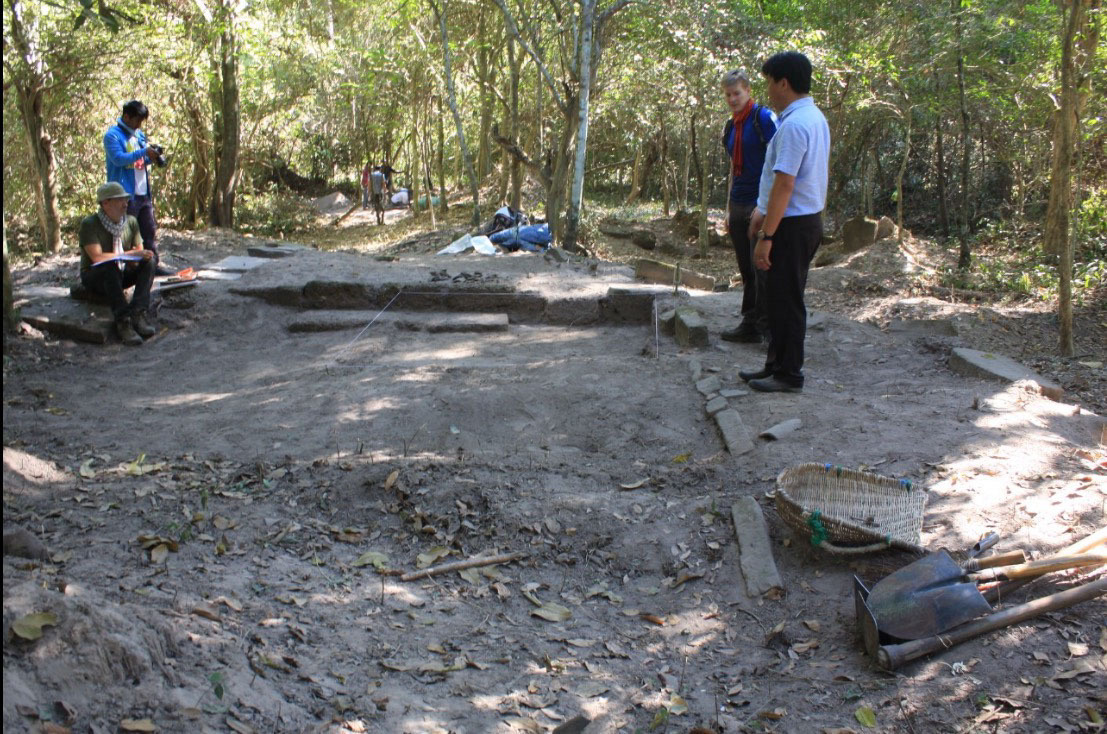
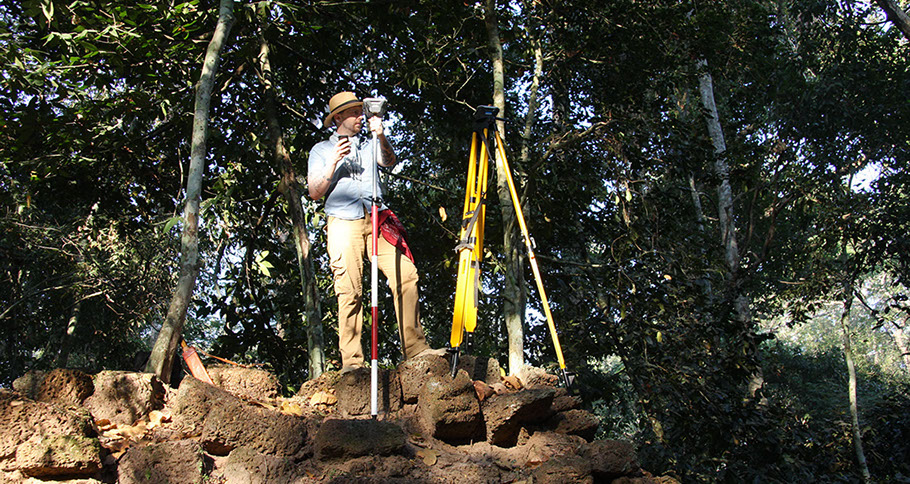
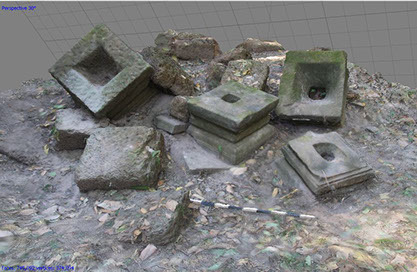
AVP investigations have combined systematic survey, structural clearance, and targeted excavation to document and analyse Angkor Thom’s surviving Buddhist Terraces alongside the urban history of late Angkor. Early survey work (2017-2018) ground-truthed potential vihara sites using historic maps, LiDAR, and GIS, while subsequent seasons (2019, 2022-2025) have comprised structural clearance, 3D mapping, subsurface sediment coring, ground-penetrating radar survey, and the excavation of over fifty test pits and larger trenches across seven Buddhist Terrace sites. Of note are excavations of Buddhist Terrace ATV009 (2023-2025), near Angkor Thom’s central Bayon temple, a multi-phase monastic site that has helped redefine construction and occupation trends in Angkor’s final centuries, and ATV027 (2022, 2025), where possibly the first later-period statue production sites in Angkor was identified, revealing the scale and diversity of monastic craft and religious activity within a more decentralized urban landscape. Important initial results include the redefinition of Angkor Thom’s major monastic building boom to the 13th–14th centuries, whereas previous scholarship associated these activities with the 16th-century restoration of Angkor Wat as a Buddhist pilgrimage site.


In sum, research by AVP has thus far demonstrated how religious practice, community organization, and adaptation to environmental and political change were negotiated through Angkor Thom’s re-envisioned built environment. In this way, studies of Buddhist Terrace complexes have not only revealed patterns of social and religious transition, but also how communities responded and adapted to environmental pressures and shifting geopolitical landscapes over time.

Upcoming fieldwork will focus on the clearance of additional Buddhist Terrace sites in the Northeast Quadrant of Angkor Thom for purposes of documentation and preservation, using GPR survey to reconstruct a major, partially buried monastic complex east of Angkor Thom’s Preah Pithu temple complex, and investigating the citadel’s later urban history through sediment coring of now-dried ponds, moats, and canals.

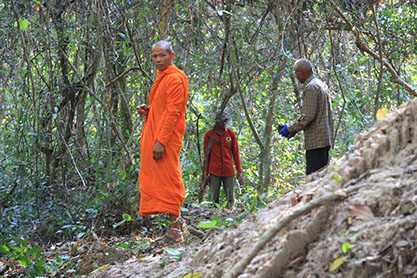
We thank Cambodia’s APSARA National Authority for all past and future permissions to complete fieldwork, as well as the local sangha (monastic order) for conducting site blessings at the beginning of each excavation.


Primary Investigator:
Andrew Harris
andrewsrharris712@gmail.com
https://nus.academia.edu/AndrewHarris
https://www.researchgate.net/profile/Andrew-Harris-39
Select Publications
Harris, A., Tin, T., Chhay R., and Vitou, P. (2023) “Broken Buddhas, Burials, and Sanctuary-Adjacent Sanctuaries: Ancestral Animist Archaeologies of Angkor’s Ancient Places and Things. World Archaeology, 55(2), 167-188, https://doi.org/10.1080/00438243.2024.2354807
Harris, A. (2023) Sīmā Boundary Markers of Angkor: A Critical Reappraisal. Artibus Asiae, 82(2), 141-178.
Harris, A., Tin, T., Soeng, S., He, H., Chheng, V., and Chhouk, S. (2022) Towards a Temporal Assessment of Angkor Thom’s Theravada “Buddhist Terrace” Archaeology. Asian Archaeology, 6, 167-183. https://doi.org/10.1007/s41826-022-00056-y
Harris, A. (2019) An Old Ritual Capital, A New Ritual Landscape: Understanding the Transformation of Angkor Thom, Cambodia, through the Construction and Placement of Theravada “Buddhist Terraces”. Medieval Worlds, 9, 4-62.
Technical/Field Reports (Available by Request)
Harris, A., Shimoda, M., Chhay, R., Chhun, S., and Monteith, F. (2024) Angkor Vihara Project Activity Report, 2024 Field Season: February 5th – March 8th, 2024. Presented to APSARA Authority in July 2024.
Harris, A., Chhay, R., Vitou, P., San, K., Soeng, S., He, H., Chheng, V., Monteith, F., Shimoda, M., Brotherson, D., Berquist, S., and Vranich, A. (2023) Angkor Vihara Project Phase I – Final Report (2019, 2022, and 2023 “Buddhist Terrace”/Preah Vihear Archaeological Campaigns). Presented to APSARA National Authority in April 2023.
Harris, A., Vitou, P., San, K., and Berquist, S. (2022) Angkor Vihara Project Activity Report, 2022 Field Season: February 21st – March 18th, 2022. Presented to APSARA National Authority in September 2022.
Harris, A. and Soeng, S. (2019) Angkor Vihara Project Activity Report, 2019 Field Season: January 7th – February 8th, 2019. Presented to APSARA National Authority in July 2019.